


ESPN
Disney
I use ESPN as a quick sports companion rather than as a complete replacement for every sports service on my phone. That distinction matters. The app is free to install, comes from Disney, and focuses on the things I usually want when I am away from a television: scores, news, alerts, and access to live sports where that viewing option is available. In everyday use, its value depends heavily on how good my connection is and how quickly I need information.
It is a sports app for Android and iOS, aimed at a broad audience with an Everyone 10+ content rating. The Android version requires at least Android 5.1, which makes it accessible on many older devices. Its popularity is easy to understand: the app has passed 100 million installs, carries an average rating of 4.3, and has accumulated a very large volume of user feedback. Those figures suggest a mature product, but they do not remove the need to decide whether its connected, notification-heavy style suits you.
How ESPN feels when the network is part of the experience
The first thing I notice is that this is not an app I open only to read a fixed collection of articles. Its usefulness comes from changing information. Scores move, game states develop, headlines change, and alerts arrive at moments that are only useful if the connection and timing work together. When the network behaves, the app feels immediate. I can check a score between errands, open a story during a break, or follow a live event without treating my phone like a miniature television set.
Related News

How Uber Eats Enhances User Experience with Android and iOS Updates

Jurassic World™: The Game - A Dinosaur Simulation Masterpiece

Mastering Cash App: Unlock Hidden Features and Boost Savings
That connected design is also the source of its main limitation. ESPN is most convincing when I am online and the app can refresh the information I care about. If I am underground, in a crowded stadium, on a weak mobile signal, or trying to conserve data, the experience becomes less dependable. I would not choose it on the assumption that every part of the service will remain equally useful without a connection. Its core appeal is live and current information, and current information naturally needs a working path to the service.
For a normal weekday, I find the app particularly useful in short sessions. I might glance at a scoreboard before a meeting, read one article while waiting for a train, and return later when an alert tells me something important has happened. That rhythm suits a phone better than long browsing sessions. The app can be a practical dashboard, but it can also encourage repeated checking if I allow every notification to compete for attention.
Related News

Why WhatsApp Messenger Still Makes Everyday Communication Feel Easy

Jurassic World: The Game Is the Better Dino Tycoon for Strategic Players

Threads in Real Life: Who Should Join, Lurk, or Leave

How SHEIN Turned Shopping Into an Endless Content Feed

How to Make Fortnite Feel Smarter on Mobile

Should You Switch to Microsoft Outlook on Mobile?
Live moments are useful, but they are not all the same
There is a meaningful difference between checking a finished score and trying to follow a live event through a mobile connection. A completed result is forgiving: if the page takes a moment to load, I have not missed the event itself. A live score, play update, or video stream is much less forgiving. A delay, interruption, or stalled refresh can make the experience feel behind the action, especially when I am also hearing updates from people nearby.
I therefore use the app in layers. For a casual check, I want the score and a concise update. For an event I genuinely care about, I pay more attention to the connection before relying on the phone as my main source. Live viewing is attractive when it is available and the network is strong, but I would not treat it as automatically equivalent to a stable television or home broadband setup. The phone is convenient; it is not always the most resilient screen.
The practical lesson is to decide what kind of attention I need before opening the app. If I only need confirmation, a brief visit is enough. If I want context, analysis, and live coverage, I should expect a larger data and battery commitment and allow more time for pages or streams to load. That simple distinction prevents disappointment and makes the app feel less demanding.
Gallery
What I do with alerts instead of accepting every prompt
Alerts are one of the strongest reasons to keep ESPN installed, but they are also where the experience can become noisy. A sports fan may follow several teams, leagues, and types of news, yet not every update deserves the same urgency. I recommend starting with the smallest useful set: the team or competition I genuinely follow, plus the alert types that help me act. I can then add more only when I understand how often they interrupt me.
This is more than a preference issue. A notification that arrives at the right time can save me from repeatedly opening the app. Too many alerts have the opposite effect: I start ignoring all of them, including the ones I actually wanted. On a busy day, I would rather receive a focused score or game-status update than a constant stream of loosely related headlines.
There is also a useful difference between using alerts as reminders and using them as a full live feed. Reminders help me decide when to return to the app. A full feed can turn the phone into a running commentary, which may be appropriate during a major event but excessive during ordinary work or study. My recommendation is to treat notification control as part of setup, not as an afterthought.
Using the app in real mobile situations
ESPN makes the most sense in the small gaps of a day. Imagine I am leaving work when a friend asks for the result of a game. I can open the app, find the relevant score, and answer without searching across several websites. Later, if an alert indicates a significant change, I can return for the story behind it. That sequence—quick check, timely alert, deeper reading—is where the app feels more useful than a general web search.
It is also convenient when I follow sports that do not receive equal attention in my immediate surroundings. Instead of depending on a television channel being on or a conversation happening nearby, I can use the app to keep a personal list of interests. The benefit is not just speed; it is control over which sports occupy my limited attention.
On the other hand, I would hesitate to recommend it as the only tool for someone who wants a quiet, low-interruption phone. The app is built around current events, and current events create reasons to return. A reader who mainly wants long-form articles, historical information, or a calm reading experience may prefer a dedicated publication or a browser-based routine. ESPN is at its best when immediacy matters.
Travel, stadiums, and crowded connections
Travel exposes the difference between convenience and reliability. In a hotel with a stable wireless connection, the app can be a comfortable way to catch up on scores and news. In transit, performance depends much more on signal changes and congestion. A page that loads quickly at home may take longer while moving between networks, and a live stream is especially sensitive to interruptions.
Stadium use is another mixed case. Being physically present at an event does not guarantee a strong connection; thousands of people may be trying to use their phones at once. I would use ESPN there as a supplement for checking another score or reading context, not as my only source of information about the event in front of me. If the app struggles, the experience remains understandable because the surrounding network conditions are part of the problem.
For travel days, I find it sensible to open the app before leaving a reliable connection and decide what I actually need. I may read an article then, rather than waiting until a weak signal appears. I also avoid assuming that a live video session will be practical during every journey. This is not a criticism of one particular screen; it is a realistic way to use a network-centered sports service.
When something fails and how I recover
When a score or article does not appear immediately, my first response is not to keep tapping the same control. Repeated refreshes can waste time and data without fixing a temporary connection problem. I check whether other apps are loading, switch between available connections when appropriate, and give the page a moment before trying again. If the issue is local to the app, closing and reopening it is a more sensible recovery step than repeatedly pressing refresh.
Live coverage deserves a slightly different approach. If a stream pauses, I first decide whether the event is important enough to continue troubleshooting. For a casual viewing session, I may return to scores and written updates instead. For a major event, I might move to a more stable connection before trying again. This fallback matters because the app offers several ways to stay informed; I do not have to treat video as the only successful outcome.
Alerts can also feel late when a phone has weak reception or when the device is busy. I avoid interpreting one delayed notification as proof that every update is broken. Instead, I open the app directly and compare the current score or story with the alert. For time-sensitive moments, checking the live page is more reliable than waiting passively for a notification to explain everything.
The app's scale and long history—released on June 15, 2010—make it feel established rather than experimental. Still, a mature app cannot control the quality of every network, device, or live event. My experience is better when I judge the service by the whole workflow: notification, opening the app, reading or watching, and recovering sensibly if the connection changes.
Managing data, battery, and attention
Because the app combines articles, scores, alerts, and live sports, I use it differently on Wi-Fi and mobile data. Written updates and quick score checks are naturally easier to fit into a limited data plan than extended live viewing. I prefer to save longer sessions for a dependable connection and use mobile data for the information that benefits most from immediacy.
There is a hidden trade-off in convenience: the more teams and events I follow, the more often I may open the app or receive updates. That can affect attention even when the data usage itself is modest. A focused setup is therefore both a data-conscious choice and a better reading experience. I would rather follow a few meaningful competitions closely than turn the app into an endless stream of interruptions.
Battery matters most when I watch live sports or keep the phone active for a long period. A short score check is a different task from holding the screen on through an event. I plan accordingly, especially when traveling or away from a charger. The app is free, but free installation does not mean every usage pattern has the same practical cost in data, battery, or time.
There are in-app purchases ranging from $4.99 to $79.99 per item. I would approach those carefully and decide whether a paid option genuinely improves the way I use the service. Someone who only wants scores and occasional news may have no reason to spend anything. Someone who values live sports access may view a purchase differently, but should still consider viewing habits, connection quality, and the alternatives already available to them.
Who should choose ESPN, and who should look elsewhere?
I recommend ESPN to people who want one recognizable sports hub for current scores, news, alerts, and live coverage. It is especially suitable for fans who move between home, work, travel, and social settings and want their sports information to follow them. The free entry point makes it easy to try, while the large user base suggests that it has become a familiar choice for many mobile sports fans.
I would be more cautious with someone who has a very narrow need. If all you want is one team's final score once a day, the app may feel broader and more active than necessary. A team-specific app, a simple notification service, or a browser bookmark could be calmer. If your priority is deep statistical analysis, a specialist sports database may be a better fit. If your priority is uninterrupted viewing, a television or dedicated streaming arrangement may offer more stability than a phone connection.
The app is also not ideal for a person who expects a completely self-contained experience in poor connectivity. Its strongest moments depend on timely access to changing information. I would not install it as a substitute for preparation before a long offline journey. Instead, I see it as a connected tool that works best when I can give it a reasonable signal and a clear purpose.
My final view on its connected sports experience
ESPN succeeds because it understands how people actually check sports on a phone: briefly, repeatedly, and often at inconvenient moments. Scores answer immediate questions, news adds context, alerts reduce the need to search, and live sports can make the app feel much more substantial when the connection is ready for it. The experience is strongest when I customize what reaches me and match the feature to my network conditions.
Its limitations are equally clear. Live features are more sensitive to signal quality than simple score checks, notifications can become distracting, and mobile viewing may consume more data and battery than a quick visit. The free price is appealing, but in-app purchases mean I should decide carefully what I actually need rather than assuming every part of the service belongs to the same basic experience.
For me, the best way to use it is as a flexible sports dashboard: alerts for the events I care about, quick checks when I am moving, and longer reading or viewing sessions when I have a stable connection. That approach avoids asking the app to do something it cannot reliably do in every mobile situation. If you want current sports information in one familiar place and accept that connectivity shapes the results, ESPN is a strong choice. If you want a quiet, offline-first, or highly specialized sports tool, I would choose a narrower alternative instead.
FAQs for ESPN
What features does the ESPN app offer?
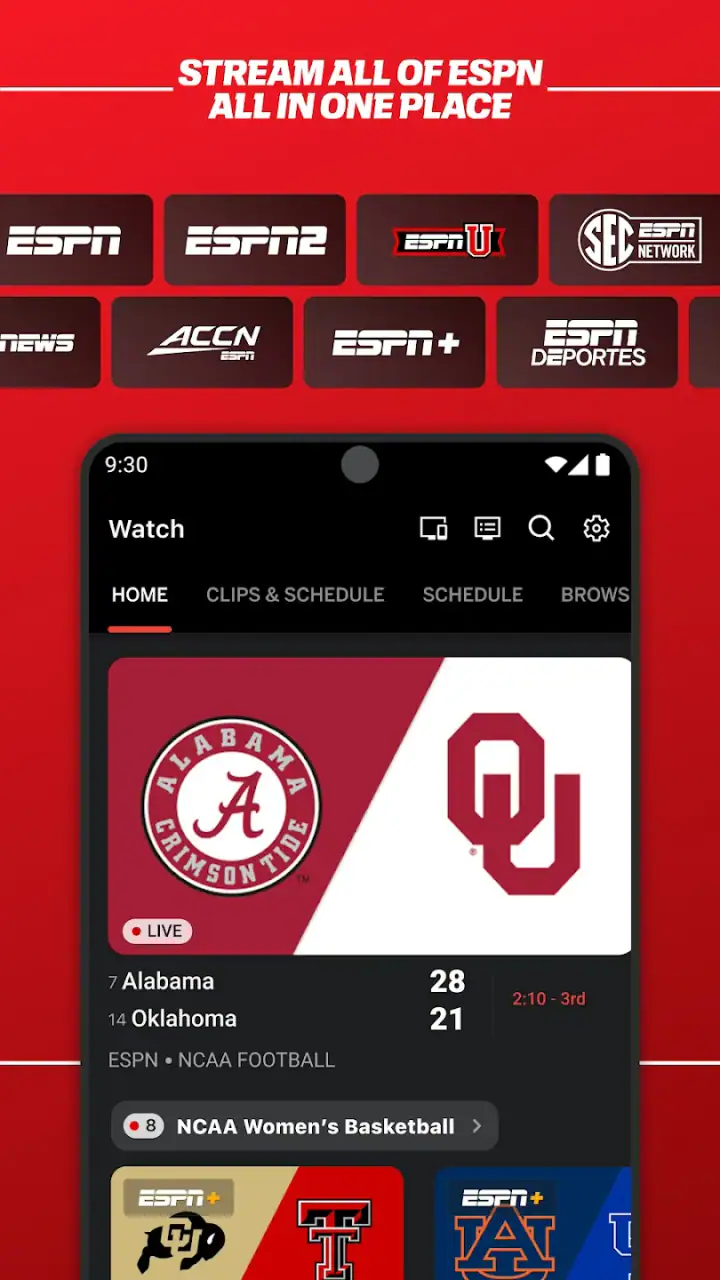
The ESPN app provides a comprehensive sports experience with live streaming of events, real-time scores, news updates, and personalized notifications. Users can also access expert analysis, highlights, and exclusive ESPN+ content. Additionally, the app supports customization, allowing fans to follow their favorite teams and leagues closely.
Is the ESPN app free to use?
The ESPN app is free to download and offers a variety of content at no cost, including scores, news, and some on-demand videos. However, certain features like live streaming of specific events and ESPN+ exclusive content require a subscription. Users should be aware that some features might also involve in-app purchases.
Can I watch live sports on the ESPN app?
Yes, the ESPN app allows users to stream live sports events. However, access to certain live games and events may require an ESPN+ subscription or a valid cable provider login. The app covers a wide range of sports, including football, basketball, baseball, and more, ensuring fans can catch their favorite games.
How can I personalize my experience on the ESPN app?
The ESPN app offers personalization options where users can select their favorite teams and sports. This customization allows the app to provide tailored content such as news, scores, and notifications specific to user preferences. By creating a profile, users can ensure they stay updated on the sports and teams they care about most.
Does the ESPN app support offline viewing?
Currently, the ESPN app does not support offline viewing for live events or most video content. Users need an active internet connection to stream live games and access the latest sports news and updates. However, highlights and some videos may be available for offline viewing with certain subscriptions.
Pros
- Comprehensive sports coverage and updates.
- Live streaming of major sporting events.
- User-friendly interface with easy navigation.
- Customizable notifications for favorite teams.
- In-depth analysis and expert commentary.
Cons
- Frequent ads can interrupt user experience.
- Some features require a subscription.
- Occasional streaming delays or lags.
- Limited access to certain international sports.
- App can be data-intensive when streaming.


